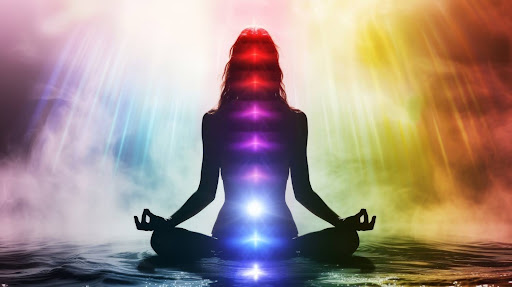
You have walked into a room and felt immediately at ease. Or met someone and felt your energy drop within minutes. That is not imagination. In yogic and Vedic science, that experience has a name: aura.
The aura is the pranic energy field that surrounds every living being. Prana, the life force described in ancient Vedic texts, moves through and beyond the physical body. What you sense in another person is often that field before anything is said or done.
This guide covers every major aura colour and its meaning, the personality traits and chakras each colour connects to, how to identify your own aura, and how to work with it through yogic practice.
What Is an Aura? The Yogic and Vedic Perspective
Most people have felt it without having a word for it. Someone walks in and the room lifts. Someone else arrives and something tightens. That is not personality. That is energy.
In Vedic science, this energy has a name and a structure. The aura is the pranamaya kosha, the pranic sheath that sits just beyond the physical body. The Upanishads describe five koshas, or layers of the self. The pranamaya kosha is the second, and it governs how prana, the life force, moves through and around you.
It is not fixed. Your emotional state changes it. Your health changes it. Years of sincere yoga and meditation practice change it in ways that tend to become visible to others before they become visible to you.
Seven layers make up the full field. Most people perceive only the innermost ones. That perception deepens with practice, specifically with the kind of sustained inner work that Rishikesh has been the centre of for centuries
Quick Reference — Aura Colours, Chakras & Personality Traits
| Aura Colour | Linked Chakra | Core Trait | Energy State |
|---|---|---|---|
| Red | Root (Muladhara) | Passion, drive | High physical energy |
| Orange | Sacral (Svadhisthana) | Creativity, joy | Emotional vitality |
| Yellow | Solar Plexus (Manipura) | Intellect, confidence | Mental clarity |
| Green | Heart (Anahata) | Healing, compassion | Emotional balance |
| Blue | Throat (Vishuddha) | Truth, wisdom | Calm communication |
| Indigo | Third Eye (Ajna) | Intuition, insight | Psychic sensitivity |
| Violet/Purple | Crown (Sahasrara) | Spirituality | Higher consciousness |
| White | All chakras | Purity, enlightenment | Rare, advanced |
| Black | — | Transformation | Deep inner cleansing |
The colour you carry most strongly is rarely fixed. It reflects where you are right now, not who you are permanently.
Let me look at what worked in the Hatha and Ashtanga articles and match that voice exactly. Short sentences. Direct. No padding.
Aura Colours and Their Meanings: Detailed Breakdown
Red Aura
Red connects to Muladhara, the root chakra. It is the most physically grounded of all aura colours. People who carry red tend to be action-oriented, direct, and hard to ignore in a room.
- High physical stamina
- Strong sense of purpose
- Decisive, sometimes impatient
The intensity that makes red aura people effective is the same thing that can tip into aggression when they are under stress. The practice for red is learning to channel rather than react.
Orange Aura
Orange belongs to Svadhisthana, the sacral chakra. It is the colour of people who feel deeply and create freely. Dancers, artists, people who light up social situations without trying.
- Naturally expressive and creative
- Emotionally generous
- Drawn to pleasure and experience
When the energy is blocked, orange can become scattered or emotionally reactive. When it flows, there is nobody more alive to the moment.
Yellow Aura
Yellow sits at Manipura, the solar plexus. It shows up in people who lead with their mind. Curious, quick, often several steps ahead of the conversation.
- Sharp intellect
- Genuine optimism
- Strong need for independence
The trap for yellow aura people is living entirely in the head. Feeling gets bypassed for analysing. The practice is learning to come down from the mind into the body.
Green Aura
Green is the heart chakra, Anahata. It is the most common colour among people who spend their lives caring for others. Nurses, therapists, teachers, parents who give without keeping score.
- Deep empathy
- Natural healer energy
- Strong draw toward nature
Green aura people absorb what they take on from others without always realising it. Without regular restoration, the well runs dry.
Blue Aura
Blue connects to Vishuddha, the throat chakra. It belongs to people who think carefully before they speak and mean every word when they do.
- Calm and measured under pressure
- Deeply trustworthy
- Natural counsellors and teachers
The difficulty for blue aura people is speaking their own needs as clearly as they hold space for everyone else’s.
Indigo Aura
Indigo belongs to Ajna, the third eye. People with indigo auras pick up on things before they can explain why. They sense the undercurrent in a room, in a person, in a situation.
- Highly intuitive
- Drawn to depth and meaning
- Sensitive to energy in ways that can be overwhelming
Without a grounding practice, that sensitivity becomes a liability. With one, it becomes one of the most useful things a person can carry.
Violet/Purple Aura
Violet sits at Sahasrara, the crown chakra. It is rare. It tends to show up in people whose spiritual practice is not occasional but central to how they live.
- Naturally drawn to service
- Philosophically inclined
- Often perceived as otherworldly by people around them
The challenge is staying rooted in daily life when awareness keeps pulling toward something larger.
White Aura
White is not one colour. It is all frequencies present at once. In Vedic understanding this reflects a state of sattva, pure clarity, the quality Patanjali points to when he describes a still, luminous mind.
- Exceptionally clear energetic field
- Deep inner stillness
- Rare, typically the result of sustained practice over years
Most people glimpse white in the aura occasionally. Very few carry it consistently.
Black Aura
Black in the aura signals transformation, not trouble. In yogic self-inquiry, svadhyaya, this is what it looks like when old patterns are being broken down before something new can form.
- Deep internal processing
- Releasing what no longer serves
- Often precedes significant personal change
Yogic tradition does not treat the shadow as something to fix. It treats it as something to understand.
How to Identify Your Aura Colour
No single method works for everyone. Start with what you can actually do consistently.
Meditation and visualisation
Sit quietly and bring attention to the space just beyond your skin. Colors rarely appear in the first session. Or the fifth. Stay with it.
The mirror technique
Plain white wall behind you, soft gaze, attention on the space around your head and shoulders. You are not looking directly. You are catching something in the periphery.
Observing your patterns
Your aura colour shows up in how you consistently behave before you ever see it. Someone who gives until empty is likely carrying green. Someone who lives in their head is probably yellow. Your patterns know before you do.
Aura photography
Kirlian photography captures the electromagnetic field around the body. The results are not definitive but they give people who need something concrete a place to begin.
Working with a practitioner
In Rishikesh this kind of work is taken seriously. Practitioners here have spent years developing sensitivity to pranic fields. One honest session can cut through a lot of guesswork.
How to Cleanse and Strengthen Your Aura
The aura responds to what you consistently do. These are the practices that actually move the needle.
Pranayama works directly on the pranic field. Nadi Shodhana, alternate nostril breathing, clears energetic blockages that accumulate through stress, poor sleep, and emotional suppression. Ten minutes daily does more than an occasional hour-long session.
Meditation stabilises what pranayama clears. Without it, the field settles back into its old patterns quickly.
Mantra chanting creates specific vibrational frequencies that affect the aura from the inside out. This is not metaphor. Sound moves through tissue and changes the nervous system in ways that modern research is only beginning to document.
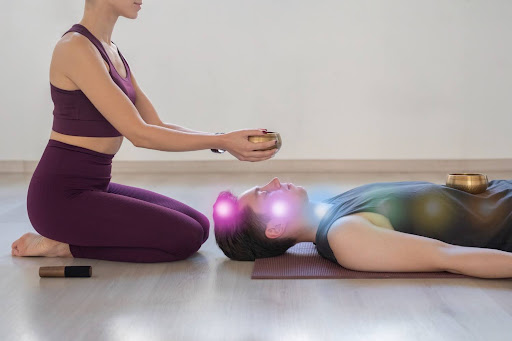
Sound healing, particularly Tibetan singing bowls, works on the same principle from the outside in. The resonance reaches layers of the field that most other practices do not.
Panchakarma, the Ayurvedic detoxification process, clears physical accumulation that blocks pranic flow. The aura cannot be bright when the body is congested.
Finally, time in nature. The Himalayan environment around Rishikesh does something that is difficult to explain and easy to feel. Most people notice a shift within days.
Aura Colours and Their Connection to the 8 Limbs of Yoga
Most conversations about aura stay at the level of colour and meaning. What they miss is the framework that makes working with the aura practical. Patanjali’s eight-limbed path, Ashtanga, is that framework.
Pratyahara, the withdrawal of the senses, is where aura awareness begins. When external noise quietens, the subtler field becomes perceptible. You cannot sense energy you are too distracted to notice.
Dharana, concentrated focus, sharpens that perception. Holding attention on a single point trains the mind to pick up frequencies it would otherwise scroll past.
Dhyana, sustained meditation, stabilises the aura itself. A consistent meditation practice does not just help you see the field more clearly. It changes what the field looks like.
Samadhi, the deepest state of absorption described in the Yoga Sutras, is associated in classical texts with a luminous, expansive aura. Not as a reward. As a natural reflection of what happens when the mind becomes genuinely still.
FAQ: Aura Colours and Their Meanings
Each colour maps to a specific chakra, energy quality, and pattern of behaviour. Red is not the same as blue. Green is not the same as indigo. The colour you carry most strongly tells you where your energy is concentrated right now, not permanently.
White and violet. Both correlate with the crown chakra and sustained spiritual development. Most people carry traces of these colours occasionally. Very few carry them as their dominant field.
They change constantly. A difficult month shows up in the field. So does a breakthrough. People who practice seriously over years often find their dominant colour shifts more than once. That is the point of the practice.
Not what most people assume. Yogic self-inquiry treats the shadow as something to work with, not fear. Black in the aura means something is being processed at depth. That is rarely comfortable and almost always necessary.
Pranayama, meditation, mantra, sound healing, Panchakarma, and time in nature all work. Rishikesh, sitting at the foot of the Himalayas, is considered one of the most naturally conducive environments in the world for this kind of work.
Green, blue, and violet appear most commonly among experienced teachers. These reflect healing, authentic communication, and depth of practice. They shift as the teacher's own practice deepens.
Conclusion
Aura awareness is not a belief system. It is a dimension of self-study that yogic tradition has treated as practical for thousands of years. The colours are not fixed labels. They are information about where you are right now and what your energy is doing with that.
The place where this knowledge is most alive is Rishikesh. Not because of the geography alone, but because the teachers, the practices, and the daily structure here are built around exactly this kind of inner work.
At Yog School India, energy work, pranayama, and meditation are woven into every program, not as extras but as the foundation.
If you want to experience that, the 200-hour yoga teacher training is where most people begin. Or start with a yoga and meditation retreat in Rishikesh and see what a week of genuine practice does to your field.