Quick Answer Box
You do not need a mat, equipment, or much space. You do not need to feel calm to begin. These practices are for people who are frightened, exhausted, and stuck indoors. They work because they act directly on the nervous system, slowing the stress response, releasing physical tension, and helping the body and mind rest. Even five minutes helps. You do not have to believe it will work. Just try it. |
If you are reading this from inside a shelter, a small room, or somewhere you cannot leave right now, this is for you. What is here does not require equipment, space, or any experience with yoga. It does not ask you to feel calm or hopeful before you start. These are simple practices for the body and mind when everything outside is frightening and uncertain. Start wherever you are.
Why the Body Needs Movement During a Crisis
When fear becomes constant, the body stops treating it as temporary. Cortisol and adrenaline, the hormones that prepare you to run or fight, stay elevated for hours, then days. Muscles tighten, particularly in the shoulders, jaw, and chest. Breathing becomes shallow. Sleep breaks apart.
The problem is that the body is preparing for a physical response that never comes. There is nowhere to run. There is nothing to fight. So the tension builds and stays.
Without movement, it has no way out. It accumulates in the body as pain, exhaustion, and a nervous system that cannot come down from high alert.
Movement, even gentle movement, gives that energy somewhere to go. Breathing slowly signals to the hormonal system that controls how stressed your body feels that the immediate threat has reduced, even briefly. That brief reduction is enough to matter.
You do not need to believe this will work. Physiology does not require belief.
How Yoga Helps You Stay Mentally Strong During War and Uncertainty
The body cannot stay at full alert indefinitely. It was not built for that. Even a few minutes of slow breathing or gentle movement gives the nervous system a partial break. Not a cure. A break. Over days and weeks, those breaks accumulate into something the body can use.
In a conflict, almost nothing is in your control. Where you sleep, whether it is safe to go outside, what happens next. A five-minute practice is something that belongs entirely to you. Small daily rituals that a person chooses for themselves have been shown to slow psychological deterioration in prolonged crises. That is not a small thing.
Fear tightens the body. A tight body sends more fear signals to the brain. Yoga does not remove the fear. What it does is interrupt that loop for a few minutes, long enough for the body to get a different message.
Chronic fear also destroys sleep, and lost sleep makes fear worse. Practices like yoga nidra and slow exhale breathing have been used with people in active conflict zones specifically for sleeplessness, without medication.
Yoga will not stop what is happening outside. What it can do is help you stay as intact as possible while it is happening.
Before You Start - One Important Thing to Know
You do not need a mat. You do not need a quiet room or a calm mind. Two square metres of floor space and five minutes is enough. These practices work in a basement, a shelter, a small flat, a tent. They work when children are around. They work when you do not feel like doing them. That last situation is often when they are most useful.
If there are other people with you, do this together. The physical effect of a group breathing slowly in the same space is measurable. It is not a wellness idea. When people breathe together, it produces a shared calming effect in the nervous system that is stronger than practicing alone. If you have family, neighbours, or anyone nearby, include them.
Breathing First - The Fastest Way to Calm the Nervous System
Most people breathe wrong when they are scared. Short, fast, high in the chest. That keeps the body stuck in alert mode. Changing how you breathe is the fastest way to interrupt that. Nothing to buy, no space needed. Just breath.
Extended Exhale Breathing
The exhale is the part that actually calms you down. Not the inhale. So make the exhale longer than the inhale. In for 4 counts, out for 6 or 8. That is the whole technique. Do it ten times. Two minutes maximum. Works for children too, just do it with them without explaining anything.
Alternate Nostril Breathing (Anulom Vilom)
Sounds complicated, it is not. Close your right nostril with your thumb, breathe in through the left. Then close the left with your ring finger, breathe out through the right. In through the right, out through the left. One round done. Do five. It is part of the yogic breathing system that has been used for centuries and the reason it works is simple – it forces the breath to slow down and that quiets a racing mind.
The 4-7-8 Breath for Sleep
Only use this one lying down at night. In for 4, hold for 7, out for 8. The long exhale at the end is what does the work. It tells the nervous system to stop bracing. Heart rate drops, chest loosens, jaw unclenches. Do it four times. Some people do not make it to the fourth round before they are asleep.
Simple Movements for a Small Space
No mat. No warm up. If you have not moved in hours, this is where to start. Four movements, each one targets somewhere the body holds fear without you realising it.
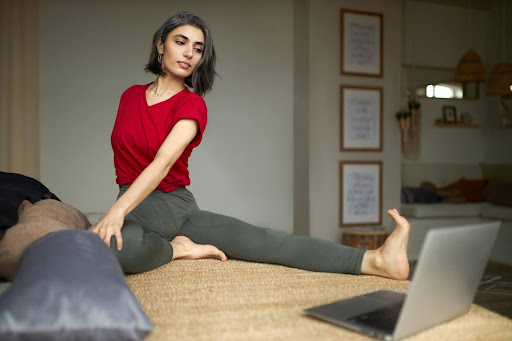
Child's Pose
Kneel on the floor. Sit your weight back toward your heels then fold forward. Forehead on the floor, or rest it on your folded arms if the floor feels too far. Stay there. One minute, two, three, whatever you have. The reason this works is simple, a forward fold like this registers as safety to the nervous system. Heart rate comes down. Breathing deepens on its own. If kneeling hurts, stuff a pillow between your heels and thighs, or fold over a rolled up jacket.
Legs Up the Wall
Sit sideways against a wall, lie back and swing your legs up. Bend your knees if you need to. Now just stay there for five to ten minutes and do nothing. Fluid drains from the legs, the lower back decompresses, the nervous system quiets. No effort involved. You are not doing anything except lying there. That is the point.
Seated Spinal Twist
Sit on the floor or a chair, whatever you have. Breathe in, sit up straight. Breathe out and turn your body to the right. Hold it for 30 seconds. Come back, then go left. Hours of sitting or crouching in one position compresses the spine and locks the chest tight. This undoes some of that. Both the floor and chair version work the same way.
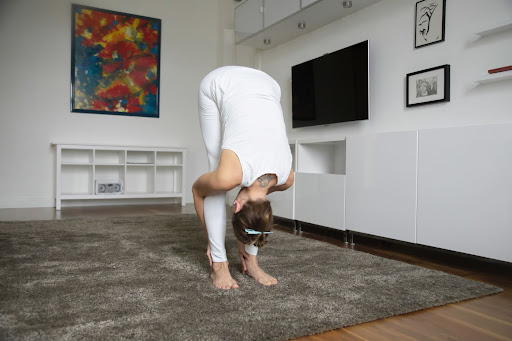
Standing Forward Fold
Stand with feet roughly hip width apart. Soften your knees, do not lock them. Then fold forward and let your head hang. No forcing, just gravity. Stay for 60 seconds then come up slowly or you will get dizzy. Anxiety pulls everything inward and upward, hunched shoulders, tight chest, shallow breath. This goes in the opposite direction. Head below heart, blood pressure drops, body starts to believe it can stand down.
Yoga Nidra - Rest When You Cannot Sleep
Yoga nidra is a lying-down practice where you stay still and slowly move your attention through each part of the body. That is it. No movement, no flexibility, no experience needed. You do not try to sleep. You just stay aware. It comes from traditional Indian yoga and is taught today at schools like Yog School India.
Roll some clothing into a pillow. Pull a coat or blanket over yourself. Lie on your back, arms slightly away from the body, eyes closed.
Start at the feet. Notice the right foot. The toes. The heel. The top of the foot. Move to the ankle. The calf. The knee. Keep going slowly up through the whole body, one part at a time, until you reach the top of the head. If the mind wanders, come back to whatever body part you left off at. It takes about 20 minutes.
Do not try to make anything happen. The point is just to keep bringing attention back to the body.
A 20 to 30 minute session of yoga nidra gives the nervous system recovery similar to several hours of sleep. This is why it has been used with UN peacekeepers, aid workers, and veterans in high-stress environments where sleep is broken or impossible.
If you have a phone with internet access, Insight Timer has free guided yoga nidra sessions that can be downloaded for offline use.
For Children - Shorter, Simpler, Playful
Children feel the same fear adults do. They just cannot sit with it the way adults try to. Movement gets it out when words cannot.
Cat Stretching
Get on hands and knees. Breathe out and round the back up toward the ceiling like a cat. Breathe in and let it drop back down. Keep going for 1 to 2 minutes. Children pick this up immediately. It releases tension in the back and chest without them needing to know that is what is happening.
Balloon Breathing
Breathe in through the nose. Puff the cheeks out and let the air out slowly through the mouth. That slow release is the same extended exhale that calms the nervous system in adults, just in a form that works from age 4. Any position, anywhere.
Shake It Out
Stand up and shake each arm and leg deliberately for about 30 seconds. This is how the body naturally discharges tension that has built up. Animals do it automatically after a threat passes. Children find it easy and often funny, which is part of why it works.
Do not force any child to practice. Offer it. Let them stop whenever they want.
Maintaining a Daily Practice When Everything Feels Uncertain
One session will not fix anything. That is not what this is about. What research on civilians in prolonged conflict consistently shows is that small daily structure reduces psychological deterioration over time. Five minutes every day is worth more than forty minutes once a week. The accumulation is what matters, not any single session.
The harder question is how to keep doing it when motivation is completely absent. The answer is not willpower. It is attachment. Pick something that already happens every day and put the practice next to it. Before the children wake up. Right after eating. When the light outside changes. The trigger does not need to be meaningful. It just needs to already exist in your day so the practice has somewhere to attach itself.
There is research-backed evidence on yoga on what daily practice does to stress hormones and sleep over time, if that context is useful.
When Yoga Is Not Enough
Yoga is a support tool. It is not a substitute for professional help and it should not be treated as one.
If you or someone with you is experiencing any of the following, seek professional support immediately:
Panic attacks that do not resolve. Inability to eat or sleep for several days. Severe distress that is not lifting. Signs of acute trauma. Thoughts of self-harm.
Do not wait to see if it passes.
Real help is available:
Frequently Asked Questions
Yes, you do not need one. Floor space is enough. If the hard floor is uncomfortable, fold a jacket under your knees or sit on a blanket. That is all.
Honestly that is most people in this situation. The breathing still works even when your thoughts are loud. You are not trying to clear your mind. Keep breathing and let the thoughts do whatever they do.
The gentle poses and breathing in this guide are generally fine. Skip the 4-7-8 breath, the breath holding is not suitable. If you can get to a health worker ask them, but the restorative poses carry very little risk.
The breathing usually does something within the first or second time you try it. Sleep takes longer, closer to a week or two of doing it regularly. Not every day has to be perfect for it to work.
Yes. Balloon breathing before sleep and slowly going through each body part have both been used with children in conflict zones. It does not require the child to understand what they are doing or why.
Conclusion:
What you are dealing with is real and it is hard. These practices do not change that.
What they can do is help the body spend a little less time at full alert. Help sleep come more easily. Give children something to do with fear that has nowhere to go. Give yourself five minutes that belong entirely to you.
That is a small thing. In the middle of a crisis it is also a real thing.
Do what you can with what you have, where you are. Even the smallest practice done consistently is worth more than waiting for the right moment or the right conditions.