


You wake up at 6am and drag yourself to the mat the practice feels heavy, forced, almost pointless. By 2pm you cannot sit still, refreshing your inbox every few minutes, already anxious about tomorrow. By 10pm you are exhausted but wide awake, your mind replaying conversations from three days ago.
This is not a mood problem. According to yogic philosophy, this is the three gunas moving through you exactly as they are supposed to.
The three gunas — Sattva, Rajas, and Tamas are the fundamental qualities of nature that shape everything: your energy, your thoughts, your food cravings, your relationships, and your spiritual progress. Understanding them is not abstract philosophy. It is one of the most practical tools a yoga school in Rishikesh can give you a map for reading your own inner weather and knowing what to do about it.
What This Guide Covers
- What Are the Three Gunas — The Foundation
- Tamas — The Guna of Inertia, Rest and Grounding
- Rajas — The Guna of Action, Passion and Movement
- Sattva — The Guna of Clarity, Balance and Inner Peace
- How the Three Gunas Shift Through Your Day
- The Three Gunas in Yoga Teacher Training
- Frequently Asked Questions
What Are the Three Gunas — The Foundation of Yogic and Ayurvedic Philosophy
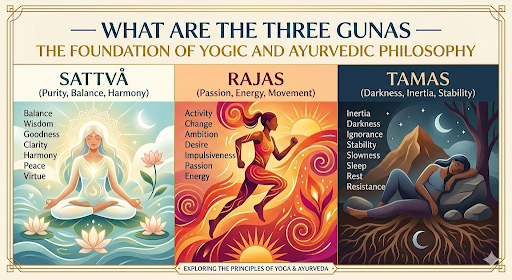
The three gunas are the fundamental qualities of nature through which everything in the universe every thought, action, food, season, and state of mind can be understood. They originate from Prakriti, the primordial nature from which all matter and mind arise, and they govern how that nature expresses itself in the world and within us.
The three gunas are Tamas (inertia and rest), Rajas (action and passion), and Sattva (clarity and balance). Together they are called the Trigunas — the three qualities of Prakriti that shape all of existence, from the movement of the planets to the quality of your sleep last night.
Crucially no one is purely one guna. All three are present in you at all times. What shifts is the proportion. A rajasic morning does not make you a rajasic person. A tamasic afternoon does not make you lazy. The gunas are fluid, dynamic, and responsive to everything you eat, think, and do.
Where Do the Three Gunas Come From?
The concept of the three gunas originates in Samkhya philosophy — one of the oldest schools of Indian thought, predating even the Vedas in some traditions. The gunas became central to yoga philosophy through the Bhagavad Gita, particularly Chapter 14, where Lord Krishna explains in detail how the three gunas bind the soul to the material world and how transcending them leads to liberation. In Ayurveda, the gunas also govern mental constitution — known as Manas Prakriti — alongside the physical doshas of Vata, Pitta, and Kapha.
Tamas — The Guna of Inertia, Rest and Grounding
Tamas is the most misunderstood of the three gunas. Every popular yoga article frames it as purely negative the guna of laziness, ignorance, and darkness. This is an incomplete picture, and understanding the difference between balanced Tamas and excess Tamas is one of the most practically useful distinctions in all of yogic philosophy.
Balanced Tamas is necessary and valuable. It gives you deep sleep, physical rest, stillness before dawn, grounding in times of overstimulation, and the capacity to slow down. Without Tamas, Rajas would burn you out completely. The stillness of deep meditation — before awareness turns to clarity — has Tamasic quality. The ground beneath your feet is Tamasic. Rest itself is Tamasic.
Excess Tamas is where the problem begins. When Tamas becomes dominant and unbalanced, it manifests as lethargy, mental fog, avoidance, resistance to change, emotional heaviness, and a pervading sense that nothing is worth starting.
The 7 Combinations of the Three Gunas
The gunas do not appear in isolation. They combine in varying proportions, creating seven recognisable patterns in personality and behaviour:
- Dominant Sattva: Calm, compassionate, wise, clear in decision-making. Drawn toward service, learning, and spiritual practice.
- Dominant Rajas: Highly active, ambitious, self-driven. Gets things done but struggles with stillness and satisfaction.
- Dominant Tamas: Heavy, resistant, withdrawn. Needs significant external support or change to shift energy.
- Dominant Sattva-Rajas: Energetic and wise. A natural teacher or leader — acts with both clarity and drive.
- Dominant Sattva-Tamas: Peaceful but sometimes passive. Deep inner life but may avoid necessary action.
- Dominant Rajas-Tamas: Restless and heavy simultaneously — driven by desire but held back by inertia. Often experiences chronic frustration.
- Balanced all three: The rare state of complete equilibrium — fluid, adaptive, unattached. The aim of sustained yogic practice.
Signs Tamas Is Dominant in You Right Now
- Feeling heavy or foggy after meals a sluggishness that lasts more than 30 minutes
- Stuck in the same decision loop for days without movement
- Scrolling your phone late at night without purpose or intention
- Avoiding your practice even though you know it would help
- Waking up already tired after a full night of sleep
- A flat sense that nothing feels interesting enough to begin
How to Shift from Excess Tamas — 4 Specific Actions
- Wake before sunrise: the pre-dawn hours are naturally Sattvic — use them for even 10 minutes of stillness rather than extra sleep.
- Begin with movement: 5 to 10 rounds of Surya Namaskar before breakfast physically lifts Tamasic heaviness in the body.
- Eat light in the morning: heavy meals for breakfast reinforce Tamas warm water, fresh fruit, or light grains shift the body into motion.
- Reduce screens after 9pm: artificial light and digital stimulation after dark reinforces Tamas in the wrong direction, disrupting the natural sleep window.
Rajas — The Guna of Action, Passion and Movement
Rajas is the engine of the world. Without it, nothing would be created, nothing would move, nothing would grow. It is the guna of motivation, creativity, ambition, and drive the force that gets you off the mat and into the world, that builds careers, raises children, and starts projects.
Balanced Rajas is not a problem to solve. It is the bridge between Tamas and Sattva. When you are heavy and stuck in Tamas, it is Rajas movement, action, engagement that lifts you toward clarity. A person without sufficient Rajas cannot act, cannot change, cannot teach.
Excess Rajas is where it turns. The mind that cannot stop planning. The body that cannot sit in meditation for three minutes without squirming. The person who books four commitments in a week and wonders why they are exhausted and irritable. The appetite for the next thing before the current thing is finished this is Rajas in overdrive.
Signs Rajas Is Dominant in You Right Now
- Checking your phone within five minutes of waking before a single conscious breath
- Mind racing at night, rehearsing tomorrow instead of resting
- Eating quickly and moving immediately to the next task without pausing
- Sharp irritability when plans change unexpectedly
- Sitting in meditation and lasting two minutes before restlessness wins
- A constant low-level feeling that you should be doing more, even on rest days
How to Calm Excess Rajas 4 Specific Actions
- Evening Yin or restorative yoga: 20 minutes of slow, held postures after 6pm signals the nervous system to begin its transition out of activity.
- Nadi Shodhana pranayama before sleep: alternate nostril breathing balances the solar and lunar channels and draws excess Rajas out of the mental field.
- Remove one commitment this week: Rajasic overload responds to subtraction, not better time management. Fewer things done fully is more Sattvic than many things done fractionally.
- Eat your meals without screens: the simple act of tasting food slowly, without distraction, begins to reduce the Rajasic urgency that drives most modern habits.
Sattva — The Guna of Clarity, Balance and Inner Peace
You have already felt Sattva. You just may not have had a name for it.
It was the morning your practice flowed without effort, one posture moving into the next as if the body already knew. The conversation felt completely honest without being difficult. The decision that came to you clearly, without deliberation, and turned out to be right. The hour after meditation when the world looked the same but felt lighter.
That quality clarity, balance, compassion, inner steadiness is Sattva. It is the guna that yogis consciously work toward because it is the state in which genuine spiritual progress becomes possible. A Sattvic mind can observe itself. It can choose. It is not driven by compulsion or numbed by inertia.
One important nuance: even Sattva can become a subtle trap. Attachment to being spiritual, wise, or peaceful is still attachment, still a form of ego identity. The Bhagavad Gita teaches that the ultimate goal is to transcend all three gunas, not to perfect one of them. For now, Sattva is the most useful direction.
How to Cultivate More Sattva — 5 Specific Practices
- Wake during Brahma Muhurta (4–6am): this window is naturally Sattvic — the environment is quiet, the mind is clear, and the nervous system is rested. Even 20 minutes of sitting in this window daily shifts the baseline guna quality over weeks.
- Sattvic diet: fresh, seasonal, lightly cooked, plant-based food. The connection between sattvic meals and yogic diet and mental clarity is not metaphorical — it is physiological. Heavy, processed, or stale food directly reduces Sattvic quality.
- Spend time in nature without your phone: 20 minutes of genuine natural light and sensory contact with the environment restores Sattvic quality in the nervous system in ways that no indoor practice fully replaces.
- Svadhyaya — honest self-study: reading philosophical texts, journaling, and reflecting truthfully on your own motivations. Not self-criticism genuine inquiry.Regular yoga practice is one of the most consistent ways to increase Sattva over time and benefits of yoga on physical and mental health show exactly why.
- Satsang: spend time with people who are calm, truthful, and genuinely interested in growth. The dominant guna of the people around you becomes, over time, the dominant guna within you.
How the Three Gunas Shift Through Your Day — A Practical Time Map
The three gunas do not only describe your general nature, they describe the quality of each window of the day. Understanding this daily rhythm is one of the most practically useful applications of guna theory. Every yogic tradition has built its daily schedule the timing of practice, meals, rest, and study around this natural guna cycle
| Time Window | Dominant Guna | What This Means for You |
|---|---|---|
| 4:00am – 6:00am | SATTVA | Brahma Muhurta — the clearest window of the day. Ideal for meditation, pranayama, and quiet reflection. The mind holds its deepest stillness here. |
| 6:00am – 10:00am | SATTVA → RAJAS | Energy begins building. Ideal for active asana practice and focused creative work while Sattvic clarity still supports the mind. |
| 10:00am – 2:00pm | PEAK RAJAS | Highest energy and productivity of the day. Best time for demanding tasks, strong practice, important decisions, and creative output. |
| 2:00pm – 6:00pm | RAJAS DECLINING | Natural energy dip. The body slows. Best time for lighter work, study, walking, and reflection rather than intense output. |
| 6:00pm – 10:00pm | TAMAS RISING | Wind-down window. Ideal for restorative practice, a light dinner, minimal screens, and preparing the nervous system for deep sleep. |
| 10:00pm – 4:00am | TAMAS (Deep Rest) | The deep rest window. Staying awake past 10pm means missing the first sleep wave making genuine rest harder even if you feel tired. |
This is why the traditional ashram schedule early morning meditation, strong asana practice in the morning, philosophical study in the afternoon, and lights out by 10pm — is not arbitrary. It is designed around the natural guna rhythm of the day. Working with this rhythm rather than against it requires no willpower. It simply requires awareness.
The Three Gunas in Yoga Teacher Training — What Every Student Should Know
Understanding the three gunas changes not just how you practice it changes how you teach. A student who does not know their dominant guna will often train in a way that reinforces their imbalance. A Rajasic student pushes harder in asana but skips meditation. A Tamasic student avoids dynamic practice and stays in their comfort zone. Neither progression is complete.
In a residential yoga teacher training, guna awareness becomes immediately practical. You observe it in yourself during the early morning meditation — the Tamasic heaviness before the practice builds, the Rajasic restlessness that arrives mid-morning, the Sattvic clarity that follows a well-taught pranayama session. The philosophy curriculum gives you the language. The daily practice gives you the direct experience.
As a teacher, the three gunas also guide how you sequence a class. A Tamasic group needs heat and movement before subtle work is possible. A Rajasic group needs grounding and stillness before they can receive philosophy. Reading the energy of a room and responding is one of the most valuable skills you develop through sustained study.
If you are comparing options across the country, this list of the top 10 best 200-hour yoga teacher training in India gives you a useful starting point.
At Yog School India, the philosophy curriculum in our 200-hour yoga teacher training in Rishikesh includes dedicated study of the Trigunas, the Bhagavad Gita’s Chapter 14, and their direct application in asana sequencing and personal practice. This is not theory for its own sake it is knowledge you use the morning after you learn it. If you are ready to study the three gunas and all of yoga philosophy in a residential setting guided by experienced teachers, explore our 200-hour yoga teacher training in Rishikesh. |
Frequently Asked Questions About the Three Gunas
What are the three gunas in yoga philosophy?
The three gunas — Sattva, Rajas, and Tamas — are the fundamental qualities of nature in yogic and Ayurvedic philosophy. Originating in Samkhya thought and central to the Bhagavad Gita, they shape all matter, mind, and personality. All three are present in everyone; their proportion shifts constantly.
What is the difference between Sattva, Rajas and Tamas?
Sattva represents clarity, balance, and inner peace. Rajas represents action, passion, and movement. Tamas represents rest, inertia, and grounding. None is inherently good or bad — each serves a purpose. The proportion of the three gunas at any given moment determines your state of mind and energy.
Which of the three gunas should I try to increase?
Sattva is the guna yogis consciously cultivate — it brings clarity, compassion, and the inner stillness needed for spiritual progress. However, all three serve a purpose. The goal is not to eliminate Rajas and Tamas but to bring Sattva into a consistent predominance without attachment to the result.
Can the three gunas change?
Yes. The gunas are dynamic and shift constantly through the day, with seasons, food choices, relationships, and lifestyle practices. Regular yoga practice and meditation consistently increase Sattva over time. The gunas are not fixed personality types they are fluid qualities that respond to conscious choices.
What foods increase Sattva guna?
Sattvic foods include fresh fruits, vegetables grown above the ground, whole grains, legumes, nuts, seeds, and dairy in moderation. These are fresh, light, and easy to digest. Processed foods, heavy meats, stale or reheated meals, and excessive spice increase Tamas or Rajas and reduce Sattvic clarity.
Where are the three gunas described in ancient texts?
The three gunas appear most extensively in Bhagavad Gita Chapter 14, where Lord Krishna explains how each guna binds the soul and how transcending all three leads to liberation. They are also central to Samkhya philosophy, the Upanishads, and Ayurvedic texts on mental constitution.
Working With the Three Gunas — Awareness Is Where It Begins
Tomorrow morning, before you open your phone, pause for a moment. Notice how you feel. Heavy and resistant, that is Tamas asking for gentle movement, not more sleep. Restless and already planning that is Rajas asking to be met with one conscious breath before it runs the day. Clear and present — that is Sattva. Work from there.
The practice is not perfection. It is noticing and making one small deliberate choice toward clarity, day after day. At Yog School India, this awareness is built into everything: the morning schedule, the philosophy sessions, the way teachers are trained to observe their own energy before they walk into a room.
Studying the three gunas is not a subject in a textbook. It is a living framework for how you show up on and off the mat one that students carry with them long after the training ends. If this way of thinking resonates with you, we would love to welcome you to our yoga school in Rishikesh.